Mesquite ISD, a district serving over 36,000 students in Texas, is reducing common special education friction points including overwhelming time demands, generalized IEPs, and overidentification of students for special education by turning secure data into faster, more individualized plans and better-informed intervention decisions.
District leaders saw an opportunity to leverage AI to improve the quality, consistency, and sustainability of special education. Mesquite ISD partnered with Panorama to address special education challenges by using Panorama Solara (a purpose-built AI platform) alongside the district’s long-standing use of Panorama Student Success.
Challenges
- Writing IEPs was a time-consuming task that took many teachers 2-3 hours of work for each IEP. Teachers needed to gather multiple sources of information—grades, attendance, assessments, behavior, parent and teacher input—often spread across systems.
- Evaluation reports could take 4-6 hours for experienced diagnosticians and up to 12 hours for new staff, with much of this time spent on manual data entry rather than analysis.
- Students received less individualized plans due to these time constraints, leading to less impactful interventions and untapped student growth potential.
- The district lacked clear insight into whether interventions were effective, creating a risk of overidentifying students for special education services.
Solution
Results
- Mesquite ISD has significantly reduced the time required to prepare IEPs and evaluation reports, allowing educators to reclaim hours previously spent on manual documentation.
- IEP drafting time now takes 45 minutes for some teachers, compared to 2-3 hours previously.
- Evaluation reports that once took 12 hours are now completed significantly faster.
- Students’ IEPs and 504 plans are more individualized and less repetitive, with goals and disability impact statements clearly grounded in current student data.
- Special education documentation is more consistent and of higher quality across campuses, supporting compliant, systemwide practices.
- With stronger interventions and more comprehensive data, assessment teams can make better informed eligibility determinations for special education services.
- Through Panorama’s partnership with Skyward, Mesquite ISD can seamlessly connect student data across systems to support more timely and informed interventions.
Challenges
Across the country, special education teams are under intense pressure with staffing shortages, rising documentation demands, and increasing expectations for individualized, legally compliant services. For Mesquite ISD, these pressures showed up in the time it took to prepare high-quality IEPs and evaluation reports, and in ensuring those plans were tailored to each student.
Time Demands and Workload Pressure
Educators had to gather and synthesize data from many sources, including assessment scores, grades, attendance, behavior records, progress monitoring data, and parent and teacher input. Much of that time was consumed not by analysis, but by logistics. Educators had to move between systems, track down records, and manually re-enter information into reports and IEP documents.
“As a seasoned educational diagnostician, it would take me anywhere from four to six hours to write an evaluation report from start to finish. As a first-year diagnostician, it took me 12 hours, said Dr. Matt Morris, Executive Director of Special Education. Once students were evaluated for receiving special education services, it would take another 2-3 hours for educators to write each IEP.
Generic or Recycled IEPs and 504s
Because of this strain on time, IEP and 504 plans sometimes relied on generic goals and template-based approaches that didn't consistently incorporate all relevant data. Educators understood the importance of individualizing each plan per student but lacked the time or tools to consistently write precise, student-specific narratives grounded in current data.
“We stress ‘No blanket accommodations.' Solara helps to ensure accommodations are created that fit each student's specific needs." said Amanda Carroll, Elementary Counseling and District 504 Coordinator. That shared belief shaped Mesquite’s ongoing work to refine IEPs and 504 plans—making them clearer for teachers and more meaningful for students.
Overidentification for Special Education Services
Beyond the documentation burden, Mesquite leaders also reflected on broader system risks tied to limited visibility into intervention practices. “I firmly believe that students are being overidentified for special education due to a lack of targeted interventions," said Dr. Morris. When districts lack clear insight into whether interventions are being implemented as intended, students may be referred to special education without a complete picture of the supports they have received. This could result in students being routed into more intensive services than necessary and can divert time and resources away from students who need them most.
Solution
District leaders in Mesquite were intentional about selecting a tool that could support high-quality, compliant IEPs without replacing professional judgment. Panorama Solara’s design as a purpose-built, K-12 AI platform—embedded within Panorama’s secure environment—was central to that decision.
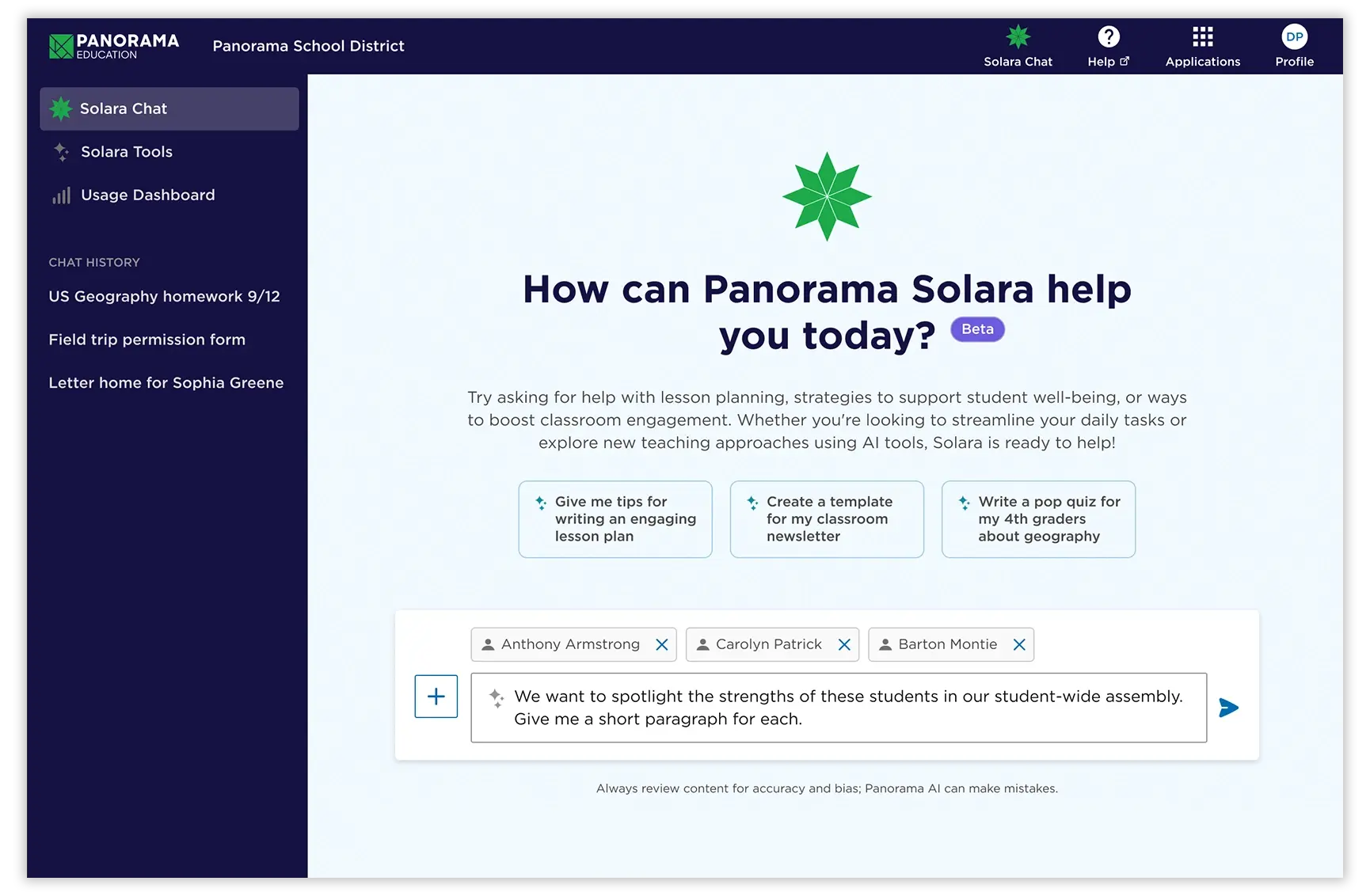
Panorama Solara securely connects with your district’s documents and Panorama data, providing AI-powered insights at the student level.
When Mesquite leaders saw a demo of Solara, they were immediately impressed. “I remember sitting across from Amanda [Carroll] thinking, how could we not? How could we not dive into this AI tool that…offers the efficiency and time management help that others don't?” said April Sarpy, Executive Director of Administrative Services.
“I was shocked by how amazing the product is,” Dr. Morris said. “Not only for the security piece, but the fact that student data is being pulled in a safe way that can’t be replicated with other AI tools.” Because Solara works with secure data already housed in Panorama, educators can use real student information without copying sensitive records into open tools.
With Solara, Mesquite’s special education staff can quickly synthesize student information that already exists in Panorama Student Success: academic data, attendance, behavior, and district documentation. "By uploading [a student's] IEP into Solara, teachers can access targeted intervention suggestions informed by real-time performance data from Panorama," said Keich Willis, At-Risk Service Coordinator.
Teachers and special education leaders in Mesquite are exploring many other use cases for Solara:
- Drafting present levels of academic achievement and functional performance (PLAAFPs) that pull from multiple data points
- Generating clearer, more specific disability impact statements
- Developing individualized goals grounded in current performance
- Preparing evaluation report sections with organized data summaries
While licensed professionals still review, revise, and finalize all documents, Solara relieves many of Mesquite’s data logistics and time pressures, freeing teams to focus more deeply on individualized instruction and meaningful student progress.
Results
Students feel the ultimate benefit of Solara’s impact in Mesquite. More individualized IEPs help students feel seen and ensure they receive the support they need to focus on their learning. When educators have clarity into intervention data and progress monitoring, students receive stronger interventions that ultimately lead to greater growth.
Solara has significantly reduced the time required to prepare IEPs and evaluation reports in Mesquite ISD. Staff now have more time to dedicate to direct services, collaboration, and meaningful preparation for special education meetings. Instead of navigating paperwork, educators can focus on what matters most: helping students make meaningful progress.
Mesquite reports noticeable improvements in the clarity and specificity of IEPs. Goals and impact statements are more personalized and tied to student data, and families and staff see plans that reflect their students’ individuality instead of repeating familiar practices. “The [Panorama] platform makes it easier to come up with the right course of action for a student without it being cookie cutter, where everybody gets the same thing, everybody gets the same intervention,” explained Willis.
Mesquite leaders also see value in how Panorama strengthens visibility into intervention practices and referral decisions. “I think that using Panorama district-wide is going to help us see if our teachers are really providing the interventions that students need and if achievement gaps are being closed,” Dr. Morris said. With clearer documentation of interventions and student response, assessment teams can use that information to make more informed eligibility determinations and help ensure students receive the right level of support at the right time.
By pairing secure, purpose-built AI with educator expertise, Mesquite ISD is reducing friction in special education workflows while strengthening the quality, consistency, compliance, and systemwide alignment of its services. The result is a more sustainable approach to special education—one that supports educators while keeping students at the center.
[Note: Panorama Solara does not make special education eligibility determinations.]