Collect insights with the Family-School Relationships Survey
Family-School Relationships Survey
Gather feedback to engage families in their school communities and better support students using the Panorama Family-School Relationships Survey, a research-backed survey instrument.
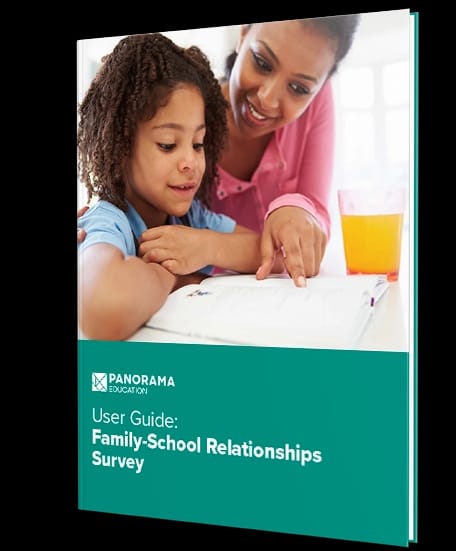
About the Panorama Family-School Relationships Survey
Research shows that when schools successfully engage families, students earn higher grades, score higher on tests, develop better social skills, and are more likely to graduate. The Family-School Relationships Survey supports that engagement by helping districts gather timely feedback, including how families want to receive information, their comfort with AI tools, and their understanding of the school’s approach to attendance.

Measuring parent attitudes to improve student outcomes
Schools can use the Family-School Relationships Survey to gather feedback while effectively engaging parents and guardians. By doing so, schools help develop parents’ capacity to contribute to their children’s learning—an important factor in promoting positive student outcomes.
Designed as a series of scales—groups of questions that capture different aspects of the same underlying theme—the Family-School Relationships Survey provides educators flexibility in measuring an array of aspects of parent attitudes.
The survey is designed for use by principals, district staff, school boards, state departments of education, or parent/teacher organizations. The survey can be administered to any K-12 school community (public, private, independent, charter, urban, or rural) and has already been used by thousands of schools nationwide.
It is available in 10 additional languages, including Spanish, Portuguese, Mandarin, and more. For schools and districts interested in advanced survey software and programs, learn more about Panorama Surveys.
Excerpt From Panorama’s Family-School Relationship Survey
School Climate
Sample question: To what extent do you think that children enjoy going to your child’s school?
School Attendance
Sample question: How important is it for your child to have good school attendance this year?
Cell Phones Impact
Sample question: Overall, how much of a distraction are cell phones in your child’s classes?
AI Priorities: Foundations
Sample question: How important is it for staff at your child's school to have professional development on AI?
School-Family Communication
Sample question: How often do you receive information from your child’s school?
Staff-Family Relationships
Sample question: At your child’s school, how respectful are the staff towards you?


Check out how districts are using the Panorama Family-School Relationship Survey to improve student outcomes

Read Success StoryWhat we realized in talking to families is that we missed the mark in terms of childcare. We've partnered with the Recreation Department and community organizations around summer programming that engage kids for a full day.

Read Success StoryWe took advantage of gathering data from a more qualitative perspective, using open-ended questions from Panorama surveys.

Read Success Story"At Stough, they've been learning from more families and how to best build family-school partnerships. The principal saw, in Panorama, that families could be better reached, and is now taking action on that data."
Testimonial 1 of 3
Frequently asked questions about the Panorama Family-School Relationship Survey
Yes. The Panorama Family-School Relationships Survey was developed under the leadership of Dr. Hunter Gehlbach, Professor and Vice Dean at the Johns Hopkins School of Education and Senior Research Advisor at Panorama Education, in collaboration with Co-Principal Investigators Dr. Karen Mapp and Dr. Richard Weissbourd from Harvard Graduate School of Education and Dr. David Kowalski, Senior Research Scientist at Panorama Education. The instrument uses advanced psychometric methodology to ensure the questions are free from bias and accurately measure complex drivers of family engagement and school climate.
Ready to elevate family, parent, and guardian voices?
Download the Family-School Relationship Survey today, or schedule time to learn how Panorama helps you collect and act on family voice data.