




Pecos-Barstow-Toyah ISD, a district in West Texas serving more than 2,900 students, is showing what it looks like to bring AI into instruction with intention. In their first year with Panorama Solara, educators are saving time, strengthening lesson planning, and building more consistent practices across classrooms.
Challenges
- Teachers at PBTISD were spending significant time on lesson planning, including building materials, differentiating content, and aligning instruction.
- Leaders were looking for an approach that could support teachers consistently across classrooms while fitting into real instructional workflows.
Solution
Results
- 55% of surveyed teachers reported using Solara for lesson planning, with many using it consistently throughout the year—an early sign of sustained use.
- 83% of teachers reported faster planning, with a project average time savings of just over 5 hours per month. That time is now being reinvested into instruction and student support.
- Teachers also reported strong confidence in what they created with Solara, with a majority describing outputs as clear, useful, and aligned to their instructional goals, and use expanding beyond lesson planning into broader instructional practices.
Challenges
At Pecos-Barstow-Toyah ISD (PBTISD), educators were looking for ways to maintain high-quality instruction while managing the growing demands on their time.
Lesson planning quickly emerged as a key opportunity. Teachers were spending significant time building materials, differentiating content, and aligning lessons to their instructional goals—work that was essential, but often time-intensive.
The district partnered with Panorama to explore how Panorama Solara—a customizable, district-wide AI platform—could support this process, with a focus on improving efficiency while maintaining the quality and alignment of instruction.
Solution
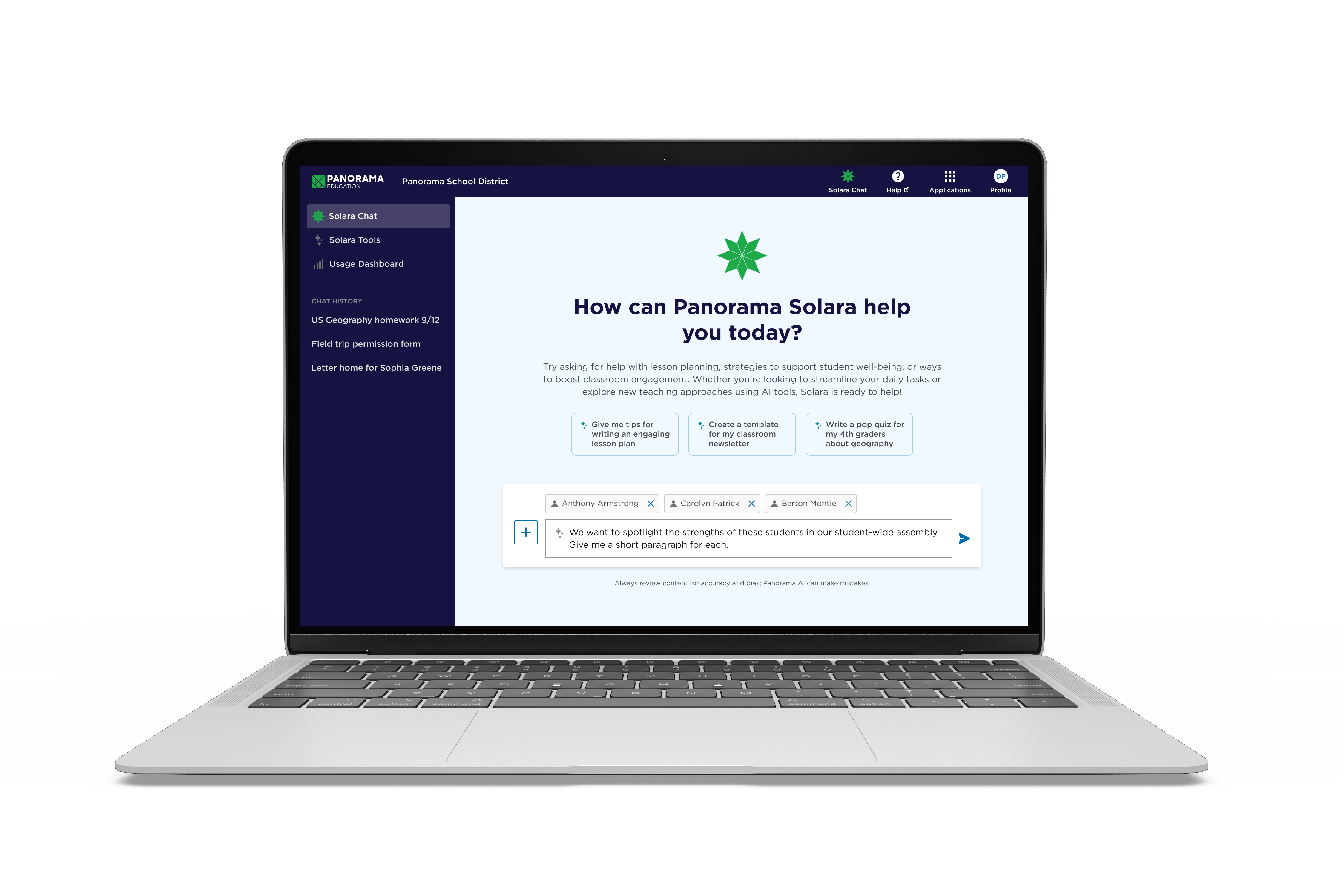
PBTISD partnered with Panorama to implement Solara, building on their existing use of Panorama Student Success to bring AI-powered support directly into their instructional workflows.
Solara was introduced to support instructional workflows, with one early use focused on lesson planning. Over time, that use expanded as educators began to explore additional applications.
Teachers started using Solara to:
- Build full lesson sequences aligned to curriculum and standards
- Generate differentiated materials for students at different levels
- Create assignments, rubrics, and pacing tools
- Develop intervention and enrichment resources
- Support professional development and planning at the team level
For many educators, the impact was noticeable. Tasks that once required hours of manual work could now be completed quickly by uploading existing materials or prompting Solara to generate aligned content. As one educator shared in a focus group, work that used to feel “very tedious” was now “a lot easier.”
Just as important, Solara’s use was reinforced through collaboration. Professional learning communities (PLCs) played an important role, giving teachers space to share prompts, refine outputs, and build confidence together. As Cynthia Smith, Secondary Curriculum Coordinator, described: “Among the teachers, once someone uses it, they share it in their PLC time. It becomes a learning session.”
This culture of openness helped Solara become a more consistent part of teachers’ workflows, supporting continued adoption and impact.
Results
Within the first year of implementation, PBTISD began to see meaningful shifts in how teachers approached planning, collaboration, and daily instructional work.
Solara Became a Consistent Part of How Teachers Approached Lesson Planning
More than half of surveyed teachers (55%) reported using Solara for lesson planning, with many returning to it regularly throughout the year. Among those users, over half had used it nine or more times—an early sign that new planning practices were starting to stick.
Teachers Gained Back Meaningful Time
As teachers incorporated Solara into their workflow, planning began to take less time. Most educators reported that the process became faster, with teachers estimating an average of just over five hours saved per month.
That shift showed up in day-to-day work. As Curriculum Coordinator Joseph Ibarra shared: “I would have spent tons and tons and tons of time creating this calendar, but just upload it in Solara and it gave me exactly what I needed.”
Time Was Reinvested Into Instruction
Teachers used time gained to strengthen what happens in the classroom. Many focused on improving materials, refining lesson plans, and personalizing instruction, while others spent more time collaborating or working directly with students.
This shift reflects a broader change, as teachers were able to focus more of their time on instruction itself.
Lesson Materials Became Easier to Build and Use
Teachers also reported that the materials they were generating were clear, useful, and aligned to their goals. A strong majority rated Solara’s outputs positively across clarity, usefulness, and alignment, making it easier to take generated content and apply it directly in the classroom.
Use Expanded Across Classrooms and Teams
In addition to lesson planning, teachers used Solara to support differentiation, assessment creation, and other instructional planning needs.
Teachers also pointed to the benefit of working within the Panorama platform. As Harley Machuca, Social Studies Teacher at Pecos High School, shared: “I really like how fast it is and how it’s integrated with our Panorama data.”
A District-Lead Approach to AI in Instruction
PBTISD’s first year with Solara reflects what’s possible when a district leads with intention, introducing AI in a way that is grounded in real instructional needs and shaped by educators themselves.
Educators across the district are not only saving time. They’re building stronger lessons, collaborating more effectively, and finding new ways to support students—shaping practices that are both more efficient and more responsive to the classroom.
For districts across Texas, the takeaway is clear: when AI is aligned to educator workflows and connected to the systems educators already use, it becomes more than a tool. It becomes part of how teaching and learning move forward.