

Schools have more tools than ever to identify students who may be at risk of chronic absenteeism. The harder question is what happens next: Which attendance interventions actually help students attend more consistently?
A new Panorama Education study offers some answers. As part of ongoing work to improve Panorama’s attendance tools, researchers analyzed attendance and intervention data from more than 230,000 students across 400+ schools during the 2025-26 school year.
What we found: across every grade level, students who completed an attendance intervention experienced improvements in subsequent attendance. Elementary and middle school students saw the largest gains, attending approximately five additional days over half a school year.
But the strategies associated with the strongest improvements differed by grade level. Elementary students benefited from a wide range of attendance supports, while layered supports showed promise in middle school and direct outreach and personalized accountability stood out in high school.
Together, the findings point to the value of a more personalized approach to attendance support. Matching interventions to students’ needs and grade level can help schools make more informed decisions about how to respond when attendance concerns emerge.
Attendance interventions led to more days in school
Across all three grade bands, students who completed attendance interventions attended more school in the weeks that followed.
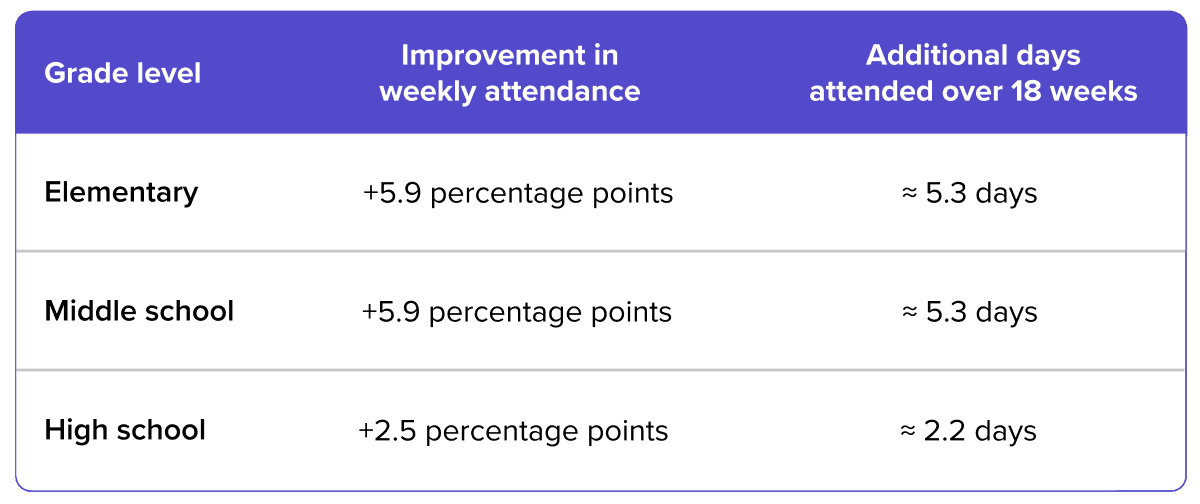
For elementary and middle school students, the estimated improvement was about 5.3 additional days of attendance over 18 weeks. The effects were relatively consistent over the 18-week post-intervention period in both grade bands.
High school students saw an estimated 2.2 additional days over the same period. Their gains were larger during the first 15 weeks after an intervention and then declined, suggesting that follow-up may be especially important for sustaining progress with older students.
These findings build on a growing body of Panorama work on attendance, including a national chronic absenteeism report and a novel approach for identifying students that are at-risk of becoming chronically absent. This research is a natural extension of that work: now that we know which students need support, how do we help those students?
What works for improving attendance changes by grade level
The study also looked at which attendance strategies showed the strongest results at different grade levels, with different patterns emerging for elementary, middle, and high school students.
These findings show which approaches were associated with improved attendance, not which was necessarily most effective or caused the improvement. Because schools selected strategies based on individual student needs, differences in results may also reflect differences among the students.
Let’s take a closer look at the findings by grade band.
Elementary school: Students benefitted from a wide range of attendance supports
Elementary students saw positive results across a wide range of individual strategies. Interventions associated with significant improvements include:
- Chronic absence letters
- Attendance contracts
- Personalized attendance plans
- Arrival check-ins
- Nudge letters
- Attendance lunch bunches
- Attendance activities planning tools
For elementary students, the findings give schools several promising options for tailoring attendance support to each student.
Middle school: Layered supports may be especially important
Middle school students saw the same 5.3-day estimated improvement over 18 weeks as elementary students. But fewer individual strategies stood out when researchers looked at them separately.
Only attendance incentive plans and attendance postcards showed statistically significant effects in the single-strategy analysis.
At the same time, more than half of middle school students that got an attendance intervention had a plan tagged with multiple strategies.
Taken together, the findings suggest that middle school students may benefit from multiple strategies working together.
High school: Direct outreach and accountability stood out
High school students saw smaller overall gains as compared to middle and elementary school students. Four strategies at the high school level were found to be effective, including:
- Attendance contracts
- Nudge letters
- Phone calls home
- Attendance incentive plans.
These results suggest that direct outreach and more individualized accountability may be promising approaches for high school students.
Three takeaways for district and school leaders
Start early. The largest estimated gains appeared in elementary and middle school. Intervention may be especially valuable before attendance challenges become more entrenched.
Tailor attendance support to students’ age and needs. The strategies associated with improved attendance varied by grade level, reinforcing the value of choosing interventions with students’ developmental needs in mind.
Track what happens after the intervention. Monitor attendance after an intervention to understand whether a student is making progress and use that information to guide next steps. That allows teams to see whether a student’s attendance changed, determine when additional support may be needed, and build a clearer picture of which approaches are working in their own schools.
Lindsay Cattell, a Senior Data Scientist at Panorama Education, uses rigorous research methods to answer educator questions, including identifying effective interventions and estimating student dropout risk.