
When Urbana School District 116 set out to strengthen its MTSS framework and tackle chronic absenteeism, leaders knew that good intentions, isolated tools, and one-off interventions wouldn’t cut it. The district needed a clear, shared vision, sustainable systems, and technology that could scale with its goals.
By bringing attendance, behavior, academic, and student survey data together in Panorama, the district has built a more coherent approach to MTSS, reduced chronic absenteeism, and seen meaningful academic growth.
- Challenges
- Student data lived across disconnected spreadsheets and systems, making it difficult to see the complete picture of students and provide the appropriate supports.
- Chronic absenteeism reached 48% following the pandemic, creating an urgent need for a more coordinated districtwide response.
- Educators lacked a shared understanding of attendance data, including the differences between chronic absenteeism, daily attendance rates, and truancy.
- Without student survey data, educators had limited insight into factors that could help them better understand student attendance, behavior, and academic performance.
- District leaders had no reliable way to verify the accuracy of manually reported attendance data, leading to errors and discrepancies.
- Results
- Chronic absenteeism in Urbana dropped from 48% to 39%, a 9-percentage-point improvement over two years, compared with a 2.5-point improvement statewide.
- The district has seen median achievement percentile for grades 1-11 roughly double, from less than 20% to 38% in reading and 33% in math.
- State assessment (IAR) reading proficiency rose from 20.7% to 26.5% over one year.
- Educators now have greater confidence in their data and can triangulate attendance, academic, behavior, and survey information to make more informed student-support decisions.
- The platform helped the district establish common definitions for metrics like chronic absenteeism, ensuring all staff across eight schools were aligned on expectations.
- The district is building a data-driven culture, keeping clear goals at the forefront and holding data meetings where staff members use Panorama to monitor growth, track interventions, and support students in real-time.
- District-wide growth trajectory:
- Across the board gains: All primary content areas showed year over year improvement in Median Achievement Percentiles:
- Math: Increased to 33% (up from 30% prior year; cohort achievement moved +3 points).
- Reading (English): Increased to 36% (up from 33% prior year; cohort growth median at 54th percentile).
- Reading (Spanish): Increased to 30% (up from 26% prior year).
- Growth pace: Math median SGP reached 50% and Reading (English) median SGP reached 54%, demonstrating that the average student in USD 116 is learning at or above the national growth norm.
- Across the board gains: All primary content areas showed year over year improvement in Median Achievement Percentiles:
Challenges
Serving more than 4,200 students across eight K-12 schools, Urbana had plenty of student data. But attendance, academics, assessments, and behavior data were all spread across different platforms and spreadsheets. Without a full picture into student performance, teams struggled to interpret the data and find actionable solutions.
For Christina Cail-Lewandowski, Urbana’s Director of Assessment and Accountability, the problem became especially clear when she moved from school leadership to the district office in 2020. She saw how cumbersome data management was, with everyone having their own spreadsheets for different purposes, some of which weren’t shared with the appropriate people. “I felt like there's got to be a better way,” she recalled.
In leadership meetings, data might go undiscussed, be taken at face value, or even become a matter of guesswork. When data was involved, fragmented systems made it impossible to validate or check someone’s work. As a result, students weren’t receiving the targeted, data-driven support they needed.
Attendance presented an especially urgent challenge. Urbana’s chronic absenteeism rate climbed as high as 48% in 2023, reflecting nationwide trends following the pandemic. “We knew it wasn't just our district, but we needed help,” Cail-Lewandowski said.
But before the district could address it effectively, staff needed a common understanding of what the data actually meant. Some educators confused chronic absenteeism with a school’s daily attendance rate or with truancy. The district needed a shared understanding of the problem if they were going to be successful in finding a solution.
Chronic absenteeism is defined as missing 10% or more school days.
Without student survey data, Urbana lacked the context to understand the student experience. “We didn't know how our kids were feeling,” Cail-Lewandowski said. They couldn’t easily connect student voice data with attendance patterns, academic performance, or behavior.
Urbana needed a way to establish what Cail-Lewandowski calls the “three C’s”: coherence, clarity, and consistency across schools.
Solution
A shared data foundation for student support
In 2021, Urbana began its Panorama partnership by administering Panorama Surveys to better understand the student experience. After a successful first year, the Panorama team approached the district with a way to take their data further and support students with Panorama Student Success.
The district added Student Success in 2022 to bring academic, behavior, attendance, and student survey data together in one platform. Urbana used a train-the-trainer approach to build internal expertise, then expanded professional learning to staff, deans, teacher leaders, administrators, and Student Education Advocates (SEAs).
Having one centralized data source gave district leaders greater confidence in the data they were using. Teams could more easily validate information, spot discrepancies, and triangulate multiple measures to understand what was really happening with a student. Panorama made it easier to spot connections across different areas of need, leading to more informed MTSS conversations and targeted support.
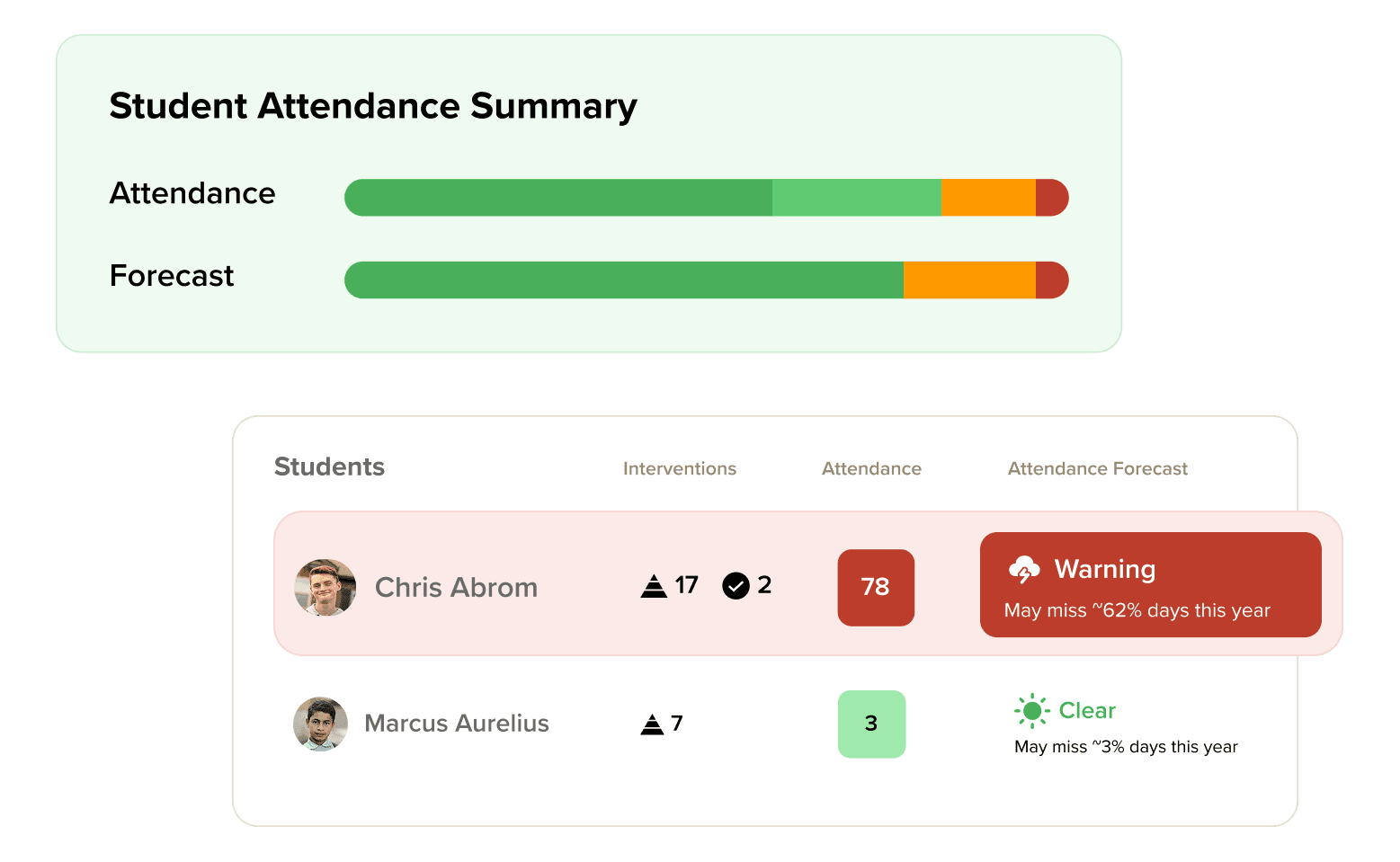
With Panorama, Urbana could finally see its attendance challenge clearly and understand what was driving it. Educators could understand how attendance related to other student data, driving home its importance for student growth. Additionally, the platform’s Chronic Absenteeism Dashboard gave leaders a consistent view of trends across schools and became the foundation for a districtwide attendance strategy.
Attendance as a Tier 1 priority
Research from Panorama helped district leaders understand the broader consequences of chronic absenteeism, including impacts on academic performance, graduation rate, and long-term outcomes. As a result, Urbana shifted its understanding of absenteeism as a problem to respond to, and instead built a culture that prioritized daily attendance.
Schools began building awareness and positive attendance habits for everyone. Across the district, schools now:
- Display grade-level attendance data in hallways and common areas.
- Send attendance-focused newsletters and communications to families.
- Use Panorama attendance letters for family outreach.
- Create schoolwide and grade-level incentives and celebrations around attendance.
- Review attendance data regularly with school leaders and staff.
- Refer to a districtwide attendance handbook.
That strong foundation even spread to Urbana’s youngest students. At the early childhood center, where attendance is not required, the principal prominently displays attendance information on a large television where families gather. “Why start the conversation in kindergarten?” Cail-Lewandowski recalled the principal asking. “Let’s start it in early childhood.”
Pair the data with targeted, human support
For students who need more help, Urbana has also strengthened the people and processes behind its attendance interventions. Cail-Lewandowski credits Panorama for illuminating the need to hire a district-level leadership role focused on attendance. The district also hired Student Education Advocates (SEAs) to serve as the “boots on the ground” in schools. They monitor attendance data, meet with principals, communicate with families, send attendance letters, and create intervention plans for students who need additional support.
Urbana is taking family engagement a step further with a new attendance committee for students with high numbers of absences. Rather than approaching families with judgment, leaders designed the committee to understand the barriers behind a student’s absences and connect families with support. They are intentionally limiting the number of administrators in the room so the meetings can feel supportive, rather than punitive.
Together, these strategies have transformed attendance into a challenge that educators across the district feel empowered to solve together.
Results
Urbana’s work has contributed to measurable progress across the district. Chronic absenteeism fell from 48% in 2023 to 39% in 2025, a nine-percentage-point improvement. Urbana’s attendance gains substantially outpaced the state average, which improved by just 2.5 points over the same time period. The district is off to a strong start to the 2026-2027 school year with a 24% chronic absenteeism rate so far.
Urbana has also seen significant academic gains. Median achievement percentile across grades 1–11 doubled in math and reading over two years. The district saw 38% proficiency in reading and 33% in math, where both had previously been in the teens. In addition, reading proficiency increased from 20.7% to 25.9% year over year on the Illinois Assessment of Readiness (IAR). Part of this growth can be attributed to educators using Panorama to triangulate assessment and student-support data and have more informed conversations about what students need.
Cail-Lewandowski is pleased to see all the pieces working together to strengthen the district’s MTSS work. She described a recent meeting where educators were considering moving a student to Tier 3 for academic support. But she was able to point to the attendance data for important context: the student had already missed four days shortly after the start of school. The bright side was that an attendance intervention plan and family outreach were already underway. Everything was working as it should.
“I feel like I'm in an orchestra,” Cail-Lewandowski said. “The violinist is doing their job, the percussion's doing their job. It's just amazing to see.”