

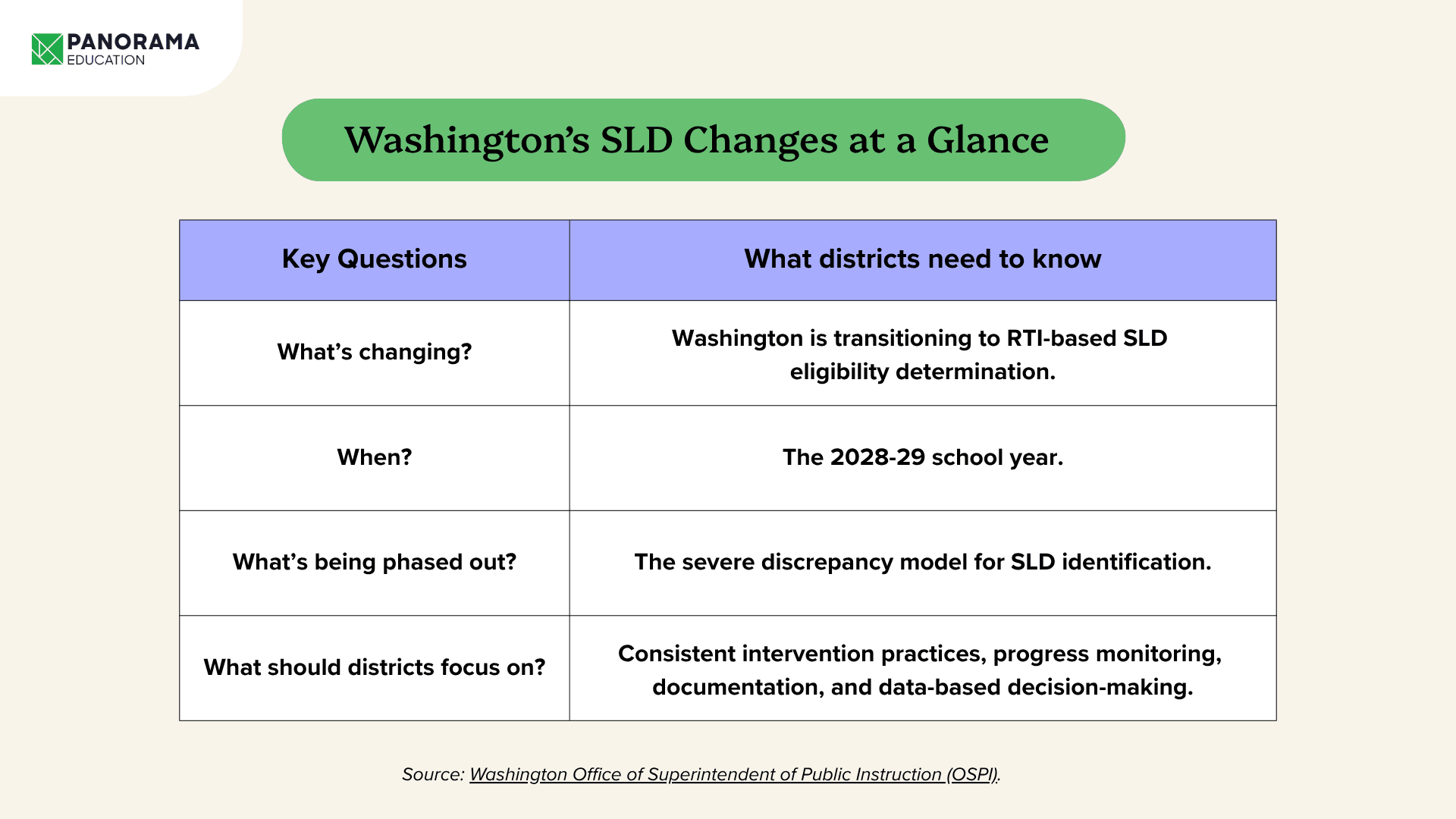
Washington is preparing for a significant change in how school districts identify students with Specific Learning Disabilities (SLD). Under the state's planned transition, beginning in the 2028–29 school year, districts are expected to use a Response to Intervention (RTI) approach to SLD eligibility determination, moving away from the severe discrepancy model.
For district leaders, the proposed change raises an important question: How can we prepare for new requirements while making sure every student gets the support they need?
Preparing for this transition means more than meeting a new requirement. Districts need reliable ways to identify students who need support, document the interventions they receive, and understand whether those interventions are making a difference.
For Washington educators, the opportunity is to build those practices now—not only to prepare for 2028–29, but to make more informed decisions and provide more coordinated support for students today.
What Is Changing With SLD Eligibility in Washington?
Currently, Washington districts can use either the severe discrepancy model or an RTI-based approach when determining whether a student has a Specific Learning Disability. The transition for 2028-29 will change how districts gather and use evidence in that process.
Moving away from the severe discrepancy model
The severe discrepancy model looks for a significant difference between a student's intellectual ability and academic achievement when considering SLD eligibility.
Under an RTI-based approach, teams examine how a student responds to scientific, research-based interventions. Rather than relying on an ability-achievement discrepancy, teams use evidence gathered through instruction, intervention, and progress monitoring to inform eligibility decisions.
This makes the quality and consistency of intervention practices especially important. Educators need to know which supports students received, how those supports were implemented, and whether students made progress.
What RTI-based identification means for evaluations
Importantly, RTI does not replace a comprehensive special education evaluation.
Under Washington's SLD evaluation rules, intervention and progress-monitoring data help inform the eligibility determination. Evaluation teams must still consider the other information required by state and federal special education law.
The distinction matters because an RTI process is not simply a checklist of interventions a student must complete before being evaluated. Federal guidance makes clear that schools cannot use RTI to delay or deny an evaluation when a disability is suspected.
RTI is also closely connected to a broader framework many Washington districts already use: a multi-tiered system of supports (MTSS).
MTSS organizes academic and nonacademic supports for all students, while RTI focuses more specifically on how students respond to instruction and intervention. A strong MTSS framework can help districts establish the consistent practices and information needed for RTI-based SLD identification.
What Does the Change Mean for Washington Districts?
Washington's transition has implications for the day-to-day work of general education teachers, interventionists, school psychologists, special education teams, and district leaders. For districts, it means examining several essential practices.
Identifying students who need support. Teams need consistent ways to recognize academic concerns and determine when additional instruction or intervention may be appropriate.
Planning and documenting interventions. Educators need a clear record of which interventions students receive, when they begin, how frequently they're delivered, and who is responsible for providing them.
Monitoring student response. Progress-monitoring data helps teams understand whether students are responding to support and when adjustments may be needed.
Maintaining accessible records. Intervention histories, assessment results, and progress-monitoring information should be available to the appropriate educators when decisions need to be made.
Connecting general and special education teams. Because RTI-based SLD identification draws on information gathered through general education instruction and intervention, collaboration across teams becomes especially important.
Consider a student receiving additional reading support. Their teacher may have screening results, an interventionist may be tracking progress, and a school psychologist may later need to review that information during an evaluation. When those records are connected, the team can more easily understand what support the student received and how the student responded.
The goal is to create a stronger, more consistent record of the support students are already receiving, one that helps educators make informed decisions throughout the student's learning experience.
How Can Washington Districts Prepare for 2028–29 Now?
Districts don't need to wait until the new SLD eligibility requirements take effect to begin preparing. A useful starting point is to examine how intervention decisions and documentation work across schools today.
Five questions to assess your district's RTI readiness
- Can teams see a student's intervention history? Is there a reliable record of which supports a student received, when they were provided, and how the student responded?
- Are intervention and progress-monitoring practices consistent across schools? Do educators use shared expectations for documenting support and reviewing student progress?
- Can general and special education teams access the information they need? Are student records available to authorized team members without requiring educators to piece together information from multiple places?
- Can district leaders see how interventions are working across buildings? Is there visibility into where students are receiving support and whether progress-monitoring practices are being implemented consistently?
- Do teams have the broader student context needed to make informed decisions? Can educators review relevant academic information alongside attendance, behavior, and other student indicators that may help them better understand a student's needs?
These questions can help districts identify where existing practices are working well and where greater consistency may be needed.
Addressing any gaps can begin with shared procedures and clearer responsibilities. Districts can also evaluate whether their existing technology supports the information-sharing and documentation practices educators need.
Build for 2028, Strengthen Student Support Today
Washington's changing SLD requirements create a reason to examine intervention systems now. But the benefits of that work can extend well beyond eligibility determination.
When educators can see a student's academic progress, attendance patterns, behavior information, and intervention history together, they have more context for understanding what the student may need. When intervention plans and progress-monitoring information are connected, teams can spend more time reviewing student response and determining appropriate next steps.
That's the approach behind Panorama Student Success, Panorama Education's MTSS and student support platform.
Student Success brings academic, attendance, behavior, assessment, and intervention information into one connected view. Educators can identify students who may need additional support, create and document intervention plans, monitor progress, and collaborate around next steps.
For district leaders, the platform also provides visibility into student-support practices across schools, helping teams understand where interventions are taking place and how students are responding.
These capabilities can support the consistent intervention and progress-monitoring practices Washington districts are strengthening as they prepare for RTI-based SLD identification. They also help educators use that same information to support students every day.
A Washington-Specific Path Forward
Washington districts preparing for the transition to RTI-based SLD identification have an opportunity to strengthen how they identify student needs, coordinate interventions, and monitor progress.
Through a partnership with the Washington School Information Processing Cooperative (WSIPC) and Skyward, Panorama for Skyward is now available as an additional product offering that eligible Washington districts can purchase through WSIPC.
Panorama for Skyward brings Panorama's student-support capabilities together with designated student information from Skyward. Skyward remains the district's student information system of record, while Panorama helps educators use student information to identify needs, plan and document interventions, monitor progress, and collaborate on next steps.
These capabilities can support districts as they evaluate and strengthen the intervention and progress-monitoring practices that are important to RTI-based approaches. Districts remain responsible for determining how their practices align with applicable state and federal requirements.
By strengthening these practices today, educators can build more coordinated approaches to student support that benefit students well beyond the 2028–29 transition.
Frequently Asked Questions About Washington's 2028 SLD Requirements
When do Washington's new SLD requirements take effect?
Washington's transition to required RTI-based identification for Specific Learning Disabilities is scheduled for the 2028–29 school year. Districts can begin preparing now by reviewing their intervention practices, progress-monitoring processes, and documentation systems.
Is Washington eliminating the severe discrepancy model?
Yes. Beginning in the 2028–29 school year, Washington districts will no longer be permitted to use the severe discrepancy model to determine SLD eligibility. The state is transitioning to an RTI-based approach.
Will Washington require RTI for SLD eligibility?
Yes. Washington's planned transition requires districts to use an RTI-based process for SLD identification beginning in 2028–29. This involves examining evidence of a student's response to scientific, research-based interventions as part of the eligibility determination.
Does Washington require districts to use MTSS?
Washington's 2028–29 change specifically concerns the use of RTI for SLD eligibility. MTSS is a broader framework that helps districts organize instruction, interventions, and student support. Washington's MTSS guidance describes how a well-implemented framework can help districts prepare for RTI-based SLD identification. Districts should consult current OSPI guidance for the specific requirements applicable to their programs.
Are RTI and MTSS the same thing?
No. RTI focuses on how students respond to instruction and interventions, including the use of that evidence in SLD eligibility determinations. MTSS is a broader framework for organizing academic and nonacademic supports for all students. RTI practices can operate within a district's MTSS framework.
Does RTI replace a comprehensive special education evaluation?
No. RTI data can inform an SLD eligibility determination, but it does not replace the comprehensive evaluation required under special education law. Schools also cannot require students to complete an RTI process before considering a referral for evaluation when a disability is suspected.
What should Washington districts do before 2028–29?
Districts can begin by reviewing how they identify student needs, document interventions, monitor progress, and share information across general and special education teams. Establishing consistent practices across schools and ensuring educators can access relevant student-support records can help districts prepare for the transition while strengthening support for students today.